

The hot summer sun was penetrating through the car windows, and while the AC was on, I recall the sweat crawling down the back of my neck. From where I was sitting, I could see the eyes of my uncle through the inside mirror. His focus was on the road, but he seemed to be distantly following the discussion my cousin and I were having. “Apparently, when we are dead and we are put in the ground, we get eaten up by all sorts of bugs and slugs,” she said matter-of-factly. “And then, we rot and we become dust and we smell very bad.” I looked at her in disbelief, my round eyes wide and my head slightly tilted. “Are you scared to die?” she asked. “I’m not going to die,” I responded confidently. She released a sly chuckle and added, “Of course you are going to die! Everyone is going to die and rot and smell bad. It’s inevitable!”. After a short silence, she continues: “The worst part is that we never know when we are going to die. Maybe now, maybe in five years, maybe in a hundred years… but, you are going to die.” Thoughts were rushing through my small brain, trying to comprehend the knowledge she was passing onto me. After what felt like an eternity, I burst into tears—a single sentence had shattered my illusion of permanence. Through blurry glances, I saw my uncle frown in the mirror, his gaze fixated on my cousin. In the background, I heard his low-pitched voice contrasting with her high-pitched defenses, but the only sound that was clear enough to reach me was my own voice repeating “I don’t want to die.”
This memory of my first encounter with the concept of death just emerged from my subconscious mind as I grieve the loss of my grandfather. Seven years have passed since, and yet the wound cracks back open each year, oozing with regrets and what ifs, I never took the time to dress properly. A dear friend recently said to me, “Grief is love that seems not to have a place to go.” That line landed with precision. Death wears the face of those we love. It is the ache that slips in between moments, like the sudden tightness in the throat when I smell patchouli, or when a Rolling Stone’s song is playing.
Frankly, it is not the fact of death that shadows me; it is the love that cannot be spent. The container of my love for him is overflowing, and the tears end up running down my cheeks way too often.
I no longer fear death. Not in the way I once did. But I do fear what gets left unsaid, the moments that will never be relived, the fact that, no matter how much I think or write about death, I will never be able to kiss his moisturized-sticky cheek one more time.
“I know why we try to keep the dead alive: we try to keep them alive in order to keep them with us. I also know that if we are to live ourselves, there comes a point at which we must relinquish the dead, let them go, keep them dead. Let them become the photograph on the table. Let them become the name on the trust accounts. Let go of them in the water. Knowing this does not make it any easier to let go of him in the water.” -Joan Didion, The Year of Magical Thinking
While death is universal, we all have a distinct way of interpreting it. I learned with age that dying signifies much more than being put in the ground, getting eaten by all sorts of bugs and slugs, rotting, becoming dust, and smelling very bad. Death is an integral part of Life; one cannot exist without the other. That might sound poetic, but it’s also profoundly structural. The world is shaped by opposites in tension—night and day, war and peace, life and death. Like Heraclitus, I believe these opposites are expressions of the same ongoing flow, like a thermometer measures the polarities of temperature—hot and cold. I found this quote from Kahlil Gibran’s The Prophet (1923) to offer a vivid representation of this dynamic between Life and Death: “Life and death are one, as the river and the sea are one.” Life as a river moves forward, carves paths, and dies the moment it meets the sea. Life, then, is not erased, not undone, but absorbed. In that view, death is life’s curvature, its direction, its edge, and without this edge, time would be flat.
Taoism teaches the same philosophy by placing death within the endless movement of Dao, “the Way”. Everything that rises must fall, everything that comes must go. A graceful turn, like a leaf letting go of its branch when the time comes. There’s no resistance in that gesture. It suggests continuation, that life and death are transformations of the same energy, the same breath, shifting shape.
In the view of Buddhism, holding on to form, to the self, to permanence, is the root of suffering. Death then becomes an invitation to loosen our grip, to recognize that nothing we are is static, nothing we love is guaranteed to remain in the form we first met it in. Death, in this frame, is not something that happens to us at the end, but something we practice at all times. Each breath is a letting go, each morning is a passing of past versions of the self, and each action is an opportunity to shed the ego. When I sit with this, I wonder if part of fearing death comes from misunderstanding what we're actually made of—treating ourselves like a fixed object, rather than a living rhythm of becoming. We fear the end as though we’ve ever truly stayed the same. Yet, through life, we’ve loved in different ways, dreamed different dreams, let go of beliefs that once defined us. We’ve changed, we’ve evolved, we’ve transitioned. We’ve died many times already.
In some cultures, the dead are kept close; they are repositioned. They become ancestors, real presences that continue to participate in the life of the community. Among the Yoruba—a cultural and spiritual civilization primarily located in Nigeria, Benin, and Togo—the dead do not vanish; they transform into a different kind of being, one that still speaks, listens, and protects. Water is offered, food is prepared, and words are spoken aloud. The relationship is maintained, the ties are not severed simply because the body has stopped moving. The dead are not feared nor romanticized; they are simply part of the social order. This idea of the dead still belonging finds a similar form in Latin American traditions, particularly in Día de los Muertos. There, the dead are celebrated, hosted, invited, and expected. Streets are filled with marigolds, songs, and laughter. Families build ofrendas, colorful altars lined with photographs, tamales, letters, flowers, and any other meaningful keepsakes. Each offering is specific, tender, sometimes even humorous: a grandmother’s Mole; a brother’s preferred cigarette brand; a child’s favorite candy. Each offering is made to welcome the dead, to cherish them.
While writing this essay, I came across a lecture about grief and cemeteries in the 1800s. In the early 19th century, death was far more visible and social than it is today in Western cultures. The first public parks were cemeteries, intentionally landscaped to feel like lush gardens, with winding paths, ponds, and shaded groves. Families would stroll, picnic among ancestors’ graves, read aloud, and celebrate in ways that felt richly soulful and communal. In short, death used to be public and familiar.
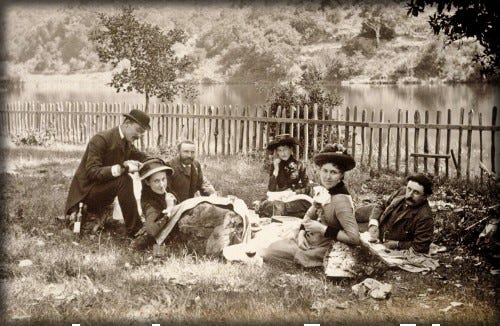
People would die at home. Their bodies were washed by loved ones and laid out in the living room for people to come talk to. Families would sleep in the same room as them. Grieving was shared and slow.
I remember waiting over seven days to be able to see the corpse of my grandfather. Because he died in a public space, an investigation was mandatory. He was detained in a facility from the day of his death until the day of his burial, nearly three weeks later. During this time, he got slit open by strangers, examined, and preserved in a sterile and cold room, far from his loved ones, alone. He was bathed and dressed up by unknown hands, made pretty and clean for us to come see. We entered a room with no windows and no furniture other than the open casket in the center. My family and I approached the coffin and discovered the pale, restful face of my grandfather. He looked like a wax figure. My grandmother lingered near his face whilst I sneaked a Rolling Stone’s guitar pick near his hand. In what felt like a glimpse, we were rushed outside—another family was waiting to see their dead.
In the other part of my family, in the island where I’m from, when someone is nearing death—especially an elder or someone long ill—the entire village becomes attentive. People lower their voices, avoid taking calls or loud laughter or music, and begin to support the family, intuitively sensing the proximity of loss. When the moment arrives, it is the toll of a bell, rung by hand, that informs the village of the death. Men gather for the veillée through the night, welcoming friends and family into the house of the dead to pay their final farewell. The next morning, wives and daughters wear black, covering their heads with laced veils. During funerals, men and women gather differently: women enter the church, men stand outside under the sun, waiting for the coffin to return from town, listening as the bells mark its slow progression home. After the burial, often held not in a cemetery but on private land among family graves, people gather around long tables, drinking wine, sharing stories, tending to one another. A full month later, a memorial mass is held, and no one dares miss it, not even estranged acquaintances. Not only for the dead, but, as they say, for those who remain. Here, grief is a collective ritual, an acknowledgement that the life lost mattered.
Growing up, I often felt uneasy about attending the veillée. I remember standing just outside the door, watching the flicker of candles, the hushed conversations, and the stillness of the body laid out in the next room. More often than not, I stayed home waiting for my parents to return from their visit. Something in me resisted crossing that threshold. Part of it was fear shaped by movies where the dead return, possessed, or vengeful. Horror films rarely show death as a transition and often frame it as something to dread. In so many images, we absorb the idea that the dead are rarely at peace or clean. They chase, they haunt, they hover. They bleed, they rot, they smell. Recently, I started to understand the veillée as an honor, as a form of accompaniment. The dead deserve witnesses in the quiet hours before their funeral, when the world is adjusting to their absence. To keep watch, to gather in the house they once lived in, to share food and memory, is to soften the passage to the afterlife, to soothe the living so the dead might leave peacefully.
A few days ago, during a phone call with my father, I mentioned I was writing an essay about death. There was a pause on the line, like he was choosing his words with care. “You know,” he finally said slowly, “I think it’s more likely than not that death is just… the end. Like a blackout, a deep sleep. That there is nothing after.” Then, after a breath, he added: “And if things are well made, we might not even be conscious of our death.” I kept silent and waited. He went on: “But I also believe in signs, in your grandmother’s guidance, and in reincarnation. But I believe because I want to, because it helps me live. Because it reassures me. What a terrifying thought to move towards death, thinking it’s a simple blackout”. I was amazed at the clarity with which he held both beliefs—the spiritual and the void—without needing to resolve either of them. We create meaning not necessarily from certainty, but from need. I don’t think he’s alone in this. For many, belief is less about conviction than it is about orientation, about a way to sand down the sharp edge of finality. Regardless of the outcome, death is a constant presence shaping our very being. Our ability to make meaning, to make choices, to live authentically, is rooted in the fact that we are finite. As Martin Heidegger puts it, we are Beings-toward-death, and in his terms, to live authentically means to live with death in view, as a reminder of what truly matters. To recognize that your time is limited is to realize that your time is yours. You can’t outsource or rewind it. Each choice we make, each refusal, each act of love or neglect, happens within the frame of finitude, imposing a sense of responsibility. Some might see death as an interruption, a mistake, a source of anxiety. The idea here is to let death illuminate the purpose of our Life by living with awareness instead of worry. In Western cultures obsessed with youth and longevity, we keep death tucked behind euphemisms, hidden in hospitals, removed from daily life. But Heidegger would argue that in denying death, we also dilute life. We tend to forget that this hour, this conversation, this breath, isn’t guaranteed to come again. And strangely, I find that this fragility is what gives life its fullness.
Thank You so much for sharing this...so beautiful,interesting,and very informative;I could relate to so much of it.I do little shrines,ofrendas,and Day of the Dead memorials for certain people I've lost;also my beloved cats,who have been there for me more than any person ever has. You are spot on about the things left unsaid,regrets thing...I've felt that a lot. I lost my partner of 25+years a year and a half ago. He was so ill he cursed at me whenever I tried to help him,but I ignored it and made sure he knew how much I loved and cared for him even through our worst times.So very glad I did that because he died suddenly.Thank you again for your very real words...💜
Thank you for sharing your views on such an important topic. Like anything we don’t want to face, death is always there, and the fear it inspires only grows in the dark. We should talk about it more often and take inspiration from the wisdom of other cultures and ancient times. I especially liked this: “We create meaning not necessarily from certainty, but from need.” When we avoid thinking about death, we forget that our time here is limited and that we should focus on what really matters every day. Our societies aren’t built for that, even though they’ve created so many pleasure-seeking activities and escapes. Much appreciated essay.